

TLDR:
- A forward deployed engineer (FDE) embeds inside your organization to build and ship production software for one customer - you - not a generic product for millions.
- Palantir coined the role in the early 2010s; FDE job postings surged ~800% in 2025 as OpenAI, Anthropic, Mistral, and Cohere raced to hire.
- Hiring one in-house is expensive and slow: US total comp runs $300K–$600K+, and it's one of the hardest roles to fill.
- You need an FDE when projects stall on "technical complexity," requirements are still moving, and you need it in production - teams using the model report 30–50% faster time-to-value.
- TechOrigins delivers the FDE model without the full-time hire: one senior team, embedded in your workflow, 75+ products shipped over 10 years - no juniors, no handoffs, ships-and-stays.
"Forward deployed engineer" went from a Palantir job title to the most-discussed role in software almost overnight. Job listings for the position have spiked roughly 800%, with hundreds of open roles across Palantir, OpenAI, Anthropic, Mistral, and Cohere, at total comp running from $300K to $600K and up. The reason isn't hype - it's that buyers finally have a name for the thing they always actually wanted: an engineer who ships, in their environment, accountable for the result.
But most content about FDEs is written for engineers who want the job. This guide is for the other side of the table - the founder, the head of product, the engineering leader who has to decide whether their company needs forward deployed engineering at all, and how to get it without a year-long search and a half-million-dollar salary line.
What is a forward deployed engineer, exactly?
A forward deployed engineer (FDE) is a senior software engineer who embeds directly with your team and writes production-grade code inside your real environment - your codebase, your cloud, your workflows. They are not in a back room writing documentation. They sit inside the problem, talk to your domain experts, and ship software that runs in production.
The distinction that matters for buyers is accountability. As The Pragmatic Engineer and a16z have both documented, an FDE owns whether the software works - not whether the slide deck was persuasive. A solutions architect designs and demos. A consultant recommends. An FDE deploys.
Forward deployed engineer vs. consultant vs. agency - at a glance
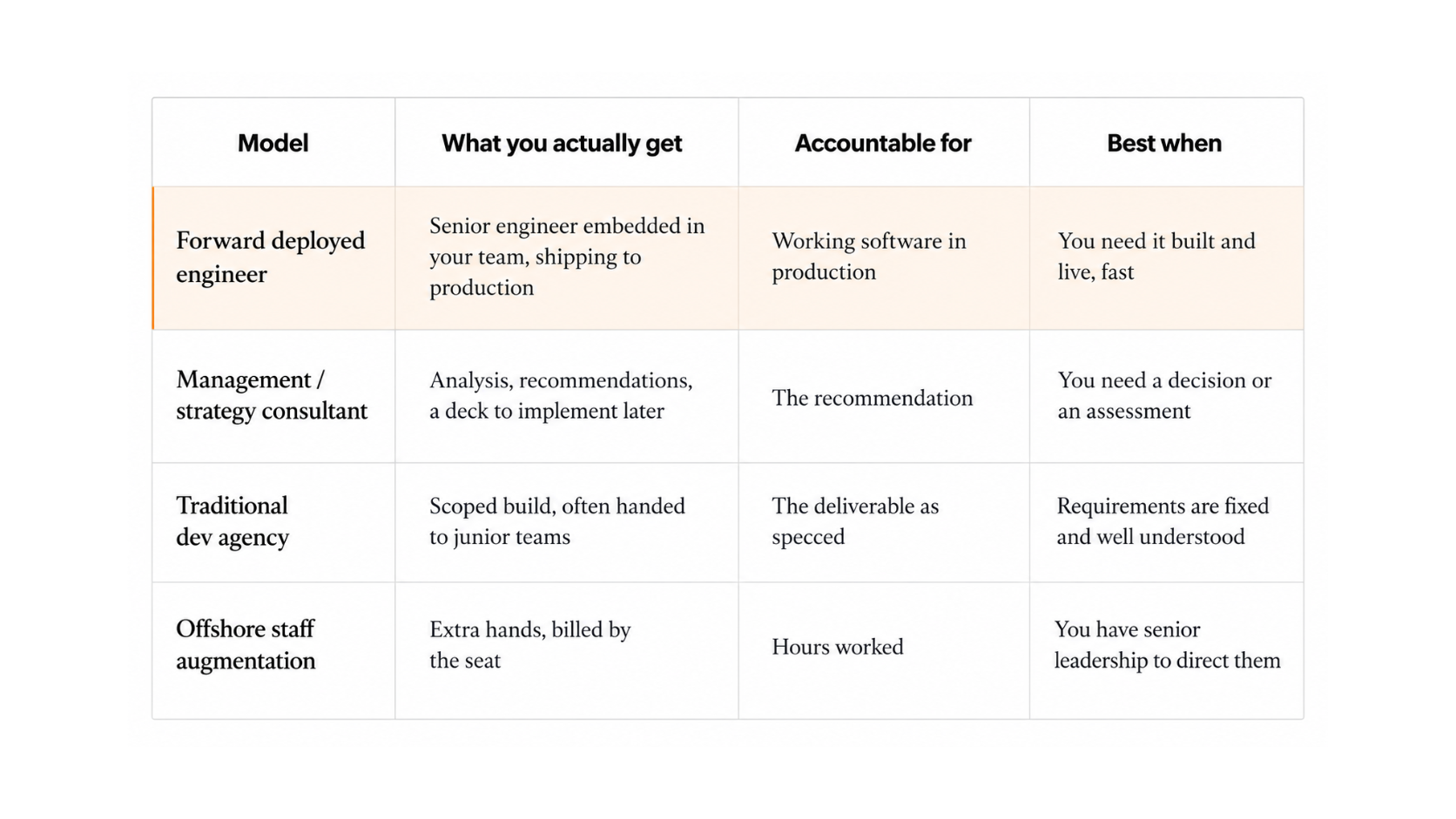
Forward deployed engineer
What you actually get: Senior engineer embedded in your team, shipping to production
Accountable for: Working software in production
Best when: You need it built and live, fast
Management / strategy consultant
What you actually get: Analysis, recommendations, a deck to implement later
Accountable for: The recommendation
Best when: You need a decision or an assessment
Traditional dev agency
What you actually get: Scoped build, often handed to junior teams
Accountable for: The deliverable as specced
Best when: Requirements are fixed and well understood
Offshore staff augmentation
What you actually get: Extra hands, billed by the seat
Accountable for: Hours worked
Best when: You have senior leadership to direct them
The 5 signs your company needs a forward deployed engineer

You don't need an FDE for every project. You need one when the bottleneck is senior execution against a moving target. Here are the signals we see most often in the founders and teams who come to us.
- Your projects keep stalling on "technical complexity."
When the reason something isn't live is always some variation of "the integration is harder than we thought," that's not a scoping problem - it's a delivery-model problem. FDEs exist to ship the last, hard mile. - You need it in production, not in a prototype.
Demos that win Twitter are easy. Software your customers depend on at 11pm is not. If the work has to survive contact with real users and real data, you need someone accountable for production - not a proof of concept. - The requirements are still moving.
If you could write a frozen spec, an agency could build it. When the right answer only emerges by sitting next to your users and iterating, you need an engineer embedded in the problem - getting it right the first cycle instead of building, then rebuilding after feedback. - You can't justify - or can't find - a $300K+ in-house hire.
Forward deployed engineers are among the hardest roles to fill in 2026, and US comp clears $300K to $600K. If you need the model but not a permanent headcount, an embedded studio gives you the same delivery without the salary line or the search. - Speed to value is the whole game.
Teams running FDE-style delivery consistently report 30–50% faster time-to-value versus implementation-led models. When every week of delay costs you a customer, a fundraise, or a season, that compression is the entire point.
In short: hire (or contract) a forward deployed engineer when the cost of not shipping - a failed launch, a stalled deal, a feature nobody uses - is larger than the cost of senior engineering time. For high-margin or deeply-integrated products, that math almost always favors the FDE.
Why the model is exploding in 2026
a16z calls it "trading margin for moat": the companies winning hardest right now are the ones willing to embed engineers with customers to make the software actually land. AI accelerated this. Off-the-shelf models are powerful, but the value lives in the last mile - wiring them into a specific company's data, workflows, and edge cases. That last mile is exactly what a forward deployed engineer is built to ship.
The catch for most companies: the labs and unicorns are absorbing the available FDE talent at $400K–$600K, and a full-time embedded engineer is overkill for a single product or launch. That's left a real gap for startups and mid-market teams who need the model without the headcount.
How to get forward deployed engineering without a full-time hire
The honest answer is that most companies don't hire an FDE - they hire a team that works like one. A senior embedded studio gives you the same three things that make the model work: one accountable senior team, embedded in your workflow, shipping to production and staying when it breaks.
That's the model we've run at TechOrigins for a decade - 75+ products shipped over 10 years, with no juniors, no subcontracts, and no handoffs. A project runs the way forward deployed engineering is supposed to:
- Discovery until the problem is clear. Calls and written scope before any design starts - so we're solving the real problem, not the first one named.
- One senior team, weekly demos. The people who scope it are the people who build it. You see working software every week, not a status report.
- Ship and stay. We launch with you and provide up to six months of post-launch support - because an FDE who disappears at go-live was never really forward deployed.
It's the same accountability a Palantir or OpenAI FDE brings to an enterprise, sized for founders and teams between an idea and a Series B. You can see live products we've shipped - generative AI studios, SaaS platforms, and conversion-tuned storefronts - all built by the senior team you'd actually be working with.
Tell us what you're building. 30 minutes. No pitch deck, no pressure. We listen, ask the questions that matter, and tell you straight whether forward deployed engineering is the right call for your project - and whether we're the right team to ship it.
→ Book a 30-min call · See the work
Forward deployed engineer FAQ
What is a forward deployed engineer?
A forward deployed engineer (FDE) is a senior software engineer who embeds directly with a customer's team and ships production-grade code inside the customer's real environment. Unlike a consultant who delivers recommendations, or a solutions architect who demos systems, an FDE writes and deploys working software that solves the business problem.
When does a company need a forward deployed engineer?
When you have a clear business outcome but lack senior capacity to ship it, when projects keep stalling on technical complexity, when off-the-shelf tools need deep custom integration, or when speed to production matters more than a long discovery phase. FDE-led delivery typically cuts time-to-value by 30–50%.
What's the difference between a forward deployed engineer and a consultant?
A consultant produces analysis and recommendations to implement later. A forward deployed engineer is accountable for working software now - they build the integrations, ship to production, and own whether it actually works. Use consultants for assessments and alignment; use FDEs when you need a shipped product.
How much does a forward deployed engineer cost?
Hiring one in-house in the US typically costs $300K–$600K+ in total compensation, and the role is hard to fill. Most startups and mid-market teams instead use an embedded engineering studio that delivers the same ship-to-production model on a project or retainer basis - without the full-time cost or the hiring search.
Can a startup use the forward deployed model without hiring full-time?
Yes. A senior embedded studio gives startups FDE-style delivery - one accountable senior team that embeds in your workflow, ships to production, and stays for post-launch support - without the $300K+ full-time hire or the hiring timeline. It's how most seed-to-Series-B teams access the model.
Sources: a16z - Services-Led Growth; The Pragmatic Engineer - Forward Deployed Engineers; First Round Review - So You Want to Hire an FDE; Palantir - A Day in the Life of an FDSE.