
Series A funding brings a familiar problem for SaaS leaders: aggressive roadmaps, ambitious revenue targets, and a core engineering team that is already at capacity. Deciding between staff augmentation vs outsourcing can determine whether you hit your milestones or slip key releases by quarters.
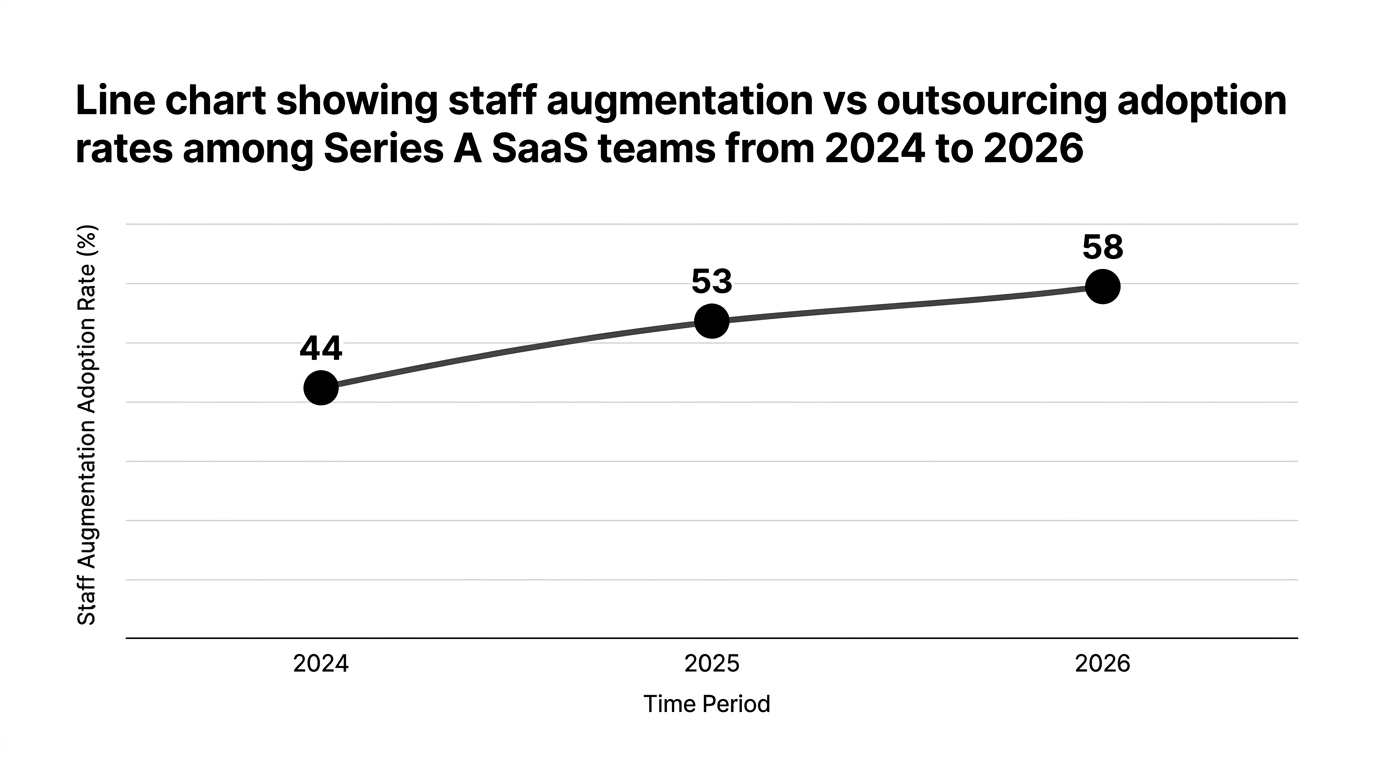
A recent SaaS scaleup survey found that 71% of Series A SaaS companies cited an engineering capacity crunch as their biggest product delivery challenge in the first 18 months post-funding (SaaS Scaleup Survey 2026). At the same time, a major SaaS operations review reported that 58% of startups chose staff augmentation over full outsourcing for product builds, with control and speed as primary drivers (Pitchbook SaaS Operations Review 2026).
This article provides a practical framework for Series A founders, Heads of Engineering, and Product Leaders to decide when staff augmentation vs outsourcing is the right move, how this choice affects delivery speed and quality, and how TechOrigins approaches hybrid models that protect your core IP while shipping fast.
Staff Augmentation vs Outsourcing: What Series A SaaS Teams Really Need
Before optimizing your delivery model, you need precise definitions that match how high-growth SaaS teams actually work.
Staff augmentation means you add external engineers, designers, or product specialists into your existing team. They join your rituals, follow your engineering practices, and work under your product and engineering leadership. Think of this as engineering team extension, not a separate vendor project.
Outsourcing means you assign a scoped project or module to a third-party team that manages delivery. They handle staffing, process, and day-to-day execution, while you set direction and acceptance criteria. This is closer to product development outsourcing than hiring individuals.
The distinction between outsourcing vs staff augmentation matters because it determines:
- Who owns architecture decisions and technical debt
- How fast knowledge transfers into your internal team
- How easily you can pivot roadmap or scope mid-flight
A McKinsey SaaS study found that companies using engineering staff augmentation reduced product iteration cycles by 23% compared with teams relying only on outsourcing (McKinsey State of SaaS Engineering 2026). For Series A companies, shorter iteration cycles typically translate directly into faster product market fit learning.
Line chart showing line chart showing staff augmentation vs outsourcing adoption rates among series a saas teams from 2024 to 2026 — data visualization for staff augmentation adoption rate (%)
The Capacity Crunch: Why Scaling SaaS Teams Breaks After Series A
Series A usually comes with a new reality: the market expects you to behave like a scaled company, while you still operate like a lean startup. That tension is most visible in SaaS engineering capacity.
A global benchmark found that 89% of Series A SaaS executives ranked flexibility to scale engineering resources up or down quickly as a top-three factor in selecting augmentation or outsourcing partners (Gartner Future of Work in SaaS 2026). Yet internal hiring cycles for senior product engineers can run 3 to 6 months, which is completely misaligned with board-level expectations around roadmap delivery.

A small engineering team gathered around a monitor showing product roadmaps, representing SaaS capacity planning challenges Typical capacity crunch triggers include:
- New funding round with aggressive feature and platform commitments
- Large enterprise deal requiring custom integrations or compliance features
- Major refactor or replatform, often to support scale or move to headless architectures
- AI/ML initiatives that demand specialist skills your current team does not have
In this context, scaling SaaS teams with the wrong model can create a second problem: more people, but slower progress. The goal is not bodies, it is sustained throughput with controllable risk.
A SaaS delivery benchmark found that product delivery timelines were 27% shorter with blended in-house plus augmented teams compared with pure outsourcing models (BCG SaaS Delivery Benchmark 2026). The message is clear: the smartest teams treat augmentation and outsourcing as complementary tools, not opposing ideologies.
A Practical Framework: When to Use Staff Augmentation vs Outsourcing
TechOrigins uses a simple framework with Series A clients, built around four dimensions: IP criticality, scope clarity, time horizon, and leadership capacity. Use this to decide between staff augmentation vs IT outsourcing on a module-by-module basis.
1. IP Criticality: Is This Core or Context?
Ask: Does this work directly touch your core value proposition or differentiating IP?
- High IP modules: recommendation engines, pricing logic, domain-specific workflows, proprietary data models
- Low IP modules: billing adapters, reporting dashboards, admin consoles, basic integrations
Guideline:
- For high IP, prefer engineering staff augmentation so knowledge and code ownership stay inside your org
- For low IP, product development outsourcing can be efficient if requirements are reasonably clear
An expert in SaaS product leadership summarized it well: “For Series A SaaS startups, augmenting your team with domain-specialist engineers offers better knowledge transfer and long-term velocity than pure project outsourcing” (SaaS Ventures, 2026).
2. Scope Clarity: Is the Work Well Defined?
Ask: Can you write a clear acceptance test for this work today, or will it evolve as you learn?
- Evolving scope: new product bets, experimental features, early AI capabilities
- Stable scope: compliance-driven changes, known customer requests, porting existing functionality
Guideline:
- For evolving scope, prefer software team extension so external engineers can iterate with you
- For stable scope, staff augmentation vs project outsourcing becomes a commercial decision based on price, speed, and risk
3. Time Horizon: Is This a Spike or a New Normal?
Ask: Is this demand spike temporary, or does it represent your new baseline capacity requirement?
- Short-term spike: a complex enterprise deal, a fixed launch deadline, a temporary migration
- Longer-term need: entering a new vertical, building a second product, expanding platform surface area
Guideline:
- For spikes, outsourced SaaS development around specific deliverables can work well
- For new normal, use technical team augmentation to build an enduring capability that you can eventually backfill with FTEs
4. Leadership Capacity: Who Owns the Work Internally?
Ask: Do you have a product and engineering lead with the time and experience to own this work?
- Strong internal leadership: clear PM/Eng leads, roadmap ownership, defined engineering standards
- Thin leadership bandwidth: new PMs, overloaded CTO, or multiple simultaneous critical initiatives
Guideline:
- With strong leadership, engineering team extension multiplied by that leadership gives you exponential impact
- With thin leadership, outsourcing software development to a partner that can provide solution leadership may be safer, as long as you design for knowledge transfer
A principal analyst in a SaaS-focused practice observed: “The ideal blend is rapid augmentation for core IP and selective outsourcing for routine modules, maximizing both control and efficiency” (GrowthStage SaaS Forum, 2026).
Benefits and Risks: Staff Augmentation vs Software Outsourcing
Every Series A team will eventually use both. The key is understanding the trade-offs so you do not accidentally compromise your roadmap or IP.
Benefits of Engineering Staff Augmentation
- Control and alignment
Augmented engineers work inside your rituals: stand-ups, sprint reviews, architecture sessions. This keeps product direction aligned with your strategy and avoids misinterpretation of priorities.
- Faster iteration velocity
Evidence shows that companies using staff augmentation cut iteration cycles by 23% compared with pure outsourcing (McKinsey State of SaaS Engineering 2026). Faster cycles mean more experiments, more customer feedback, and fewer big-bang releases.
- Stronger knowledge transfer
Because augmented engineers are embedded, their context gradually becomes your context. Over time, they can help onboard new internal hires, shorten ramp-up time, and reduce dependency on any single third-party.
- Flexibility for Series A realities
A Forrester analysis projects 18.3% CAGR growth for SaaS staff augmentation from 2026 to 2029, outpacing general IT outsourcing (Forrester Market Analysis 2026). That growth reflects a simple fact: startups increase engineering capacity in bursts, and augmentation is structurally better suited to that pattern.
Risks and Mitigations for Staff Augmentation
- Risk: Process mismatch
If external engineers are not comfortable with your level of ambiguity or your tech stack, they slow you down. Mitigation: choose partners experienced with custom SaaS software teams and modern product practices like weekly demos and performance budgeting.
- Risk: Underused talent
If your roadmap fluctuates week-to-week, augmented engineers may be underutilized. Mitigation: set clear multi-sprint objectives and pool augmented capacity across adjacent product teams.
Benefits of Product Development Outsourcing
- Clear cost and scope control
For well-defined efforts, SaaS product launch outsourcing lets you lock scope, timeline, and budget. This can be helpful when explaining trade-offs to investors and non-technical stakeholders.
- Parallelization of initiatives
Outsourcing secondary modules lets your core team focus on foundational architecture, reliability, and innovation. This is particularly useful when you must handle both SaaS MVP delivery and refactoring legacy modules at the same time.
- Complete ownership of non-core work by partner
When a partner takes end-to-end responsibility for a module, you offload a lot of coordination effort. This can be valuable if your leadership team is stretched.
Risks and Mitigations for Outsourced SaaS Development
- Risk: Misaligned incentives
Outsourcing arrangements often reward delivering scope, not maximizing long-term product health. Mitigation: bake non-functional requirements, performance budgets, and code quality gates into contracts.
- Risk: Knowledge silo
If external teams own architecture and implementation for critical modules, your internal team becomes dependent. Mitigation: require joint design sessions, internal code reviews, and explicit documentation standards.
- Risk: Slow pivot capability
Outsourced contracts are less friendly to frequent scope changes. Mitigation: keep experimental and strategic work in-house or via engineering team extension.
A counterargument often raised is that pure outsourcing is cheaper. In practice, when you factor in rework, lost opportunity from slower iteration, and integration cost, purely outsourced SaaS development for core product often becomes more expensive over a 12 to 24 month window.
Cost, Speed, and Quality: How Delivery Models Impact Outcomes
Series A teams rarely ask "What is the absolute cheapest model?". The real question is, which model optimizes time-to-impact while controlling risk.
Data shows a clear pattern:
- Blended in-house plus augmented teams: 27% shorter product delivery timelines compared with pure outsourcing (BCG SaaS Delivery Benchmark 2026)
- Staff augmentation vs project outsourcing: augmentation correlated with shorter iteration cycles and better retention of institutional knowledge (McKinsey State of SaaS Engineering 2026)
- Partner flexibility: 34% of Series A leaders rated flexibility as the top selection criterion, followed by domain expertise, speed, and cost (Gartner Future of Work in SaaS 2026)
For practical decision-making, consider a simple "Capacity Economics" view:
- Time to start
- Staff augmentation, when using a prepared bench of remote engineering talent, can start within days
- Outsourcing often requires more upfront scoping and legal work
- Time to impact
- Augmented senior engineers usually contribute to production code in 1 to 3 sprints
- Outsourced teams may need more time for integration and clarifying assumptions
- Total cost of change
- High when outsourced teams own architecture and you later want to pivot
- Lower when augmented engineers co-design with your internal leads
A specialist analyst remarked: “Speed is everything. Companies that strategically augment can ship MVPs 30% faster without losing control over product direction” (McKinsey SaaS Practice, 2026). For Series A, that difference can be the gap between securing the next round or missing market timing.
Case Study: Blended Team Model to Resolve an Engineering Bottleneck
Consider a Series A fintech SaaS building an AI-driven risk engine. The company needed to ship its MVP in 6 months instead of the originally scoped 9 months to hit a strategic funding window.
They chose engineering staff augmentation for the core AI engine, adding five senior ML engineers into their existing team. Product and architecture stayed owned by the in-house leads, with augmented specialists contributing deep domain expertise.
At the same time, they used outsourced SaaS development for less critical components: admin tooling, internal dashboards, and certain third-party integrations.
Results, as documented in a startup growth casebook (2026):
- MVP timeline reduced from 9 months to 6 months
- New funding of 3 million dollars secured on the strength of the shipped product
- Internal team retained strong ownership of the core algorithm and platform
Another healthtech SaaS followed a similar blended model, combining in-house leadership with external senior teams. They achieved a 36% reduction in bug rates and launched two core modules within 8 months (HealthTech Scale Successes 2026). These examples illustrate that staff augmentation vs software outsourcing is not a binary choice. The most effective Series A teams treat it as an allocation problem.
Flat diagram illustration showing how augmented and outsourced workstreams connect to a central SaaS product in a hybrid engagement model
How TechOrigins Helps Series A SaaS Teams Resolve Capacity Crunch
TechOrigins was built for this exact stage. Our work across 75+ SaaS and e-commerce products has shown a consistent pattern: Series A teams succeed when they combine senior-only staff augmentation with selective outsourcing under a single, accountable partner.
Senior-Only Engineering Team Extension
TechOrigins provides dedicated SaaS developers as an extension of your core team. Our senior-only, design-led squads plug directly into your rituals, tools, and architecture.
This model works particularly well when you need:
- AI/ML specialists to build recommendation systems or risk engines
- SaaS MVP delivery partners to help you get a new product or module into market fast
- Technical team augmentation to accelerate core platform work without diluting quality
Because the same squad can also own targeted modules end-to-end, you can shift between staff augmentation vs outsourcing within a single engagement as your needs evolve.
Product Build and Outsourced Modules
For well-defined initiatives, TechOrigins also executes outsourced SaaS development with clear scopes and outcomes. Examples include:
- New Shopify-backed commerce experiences for SaaS platforms that add a storefront component
- Custom integrations with ERP, CRM, 3PL, or OMS systems
- Performance optimization and post-launch maintenance for existing SaaS or commerce products
Our teams follow practices such as weekly demos, written scope, performance budgeting, and zero-downtime launches, which reduces the risk that often comes with outsourcing.
Hybrid Engagements for Series A Teams
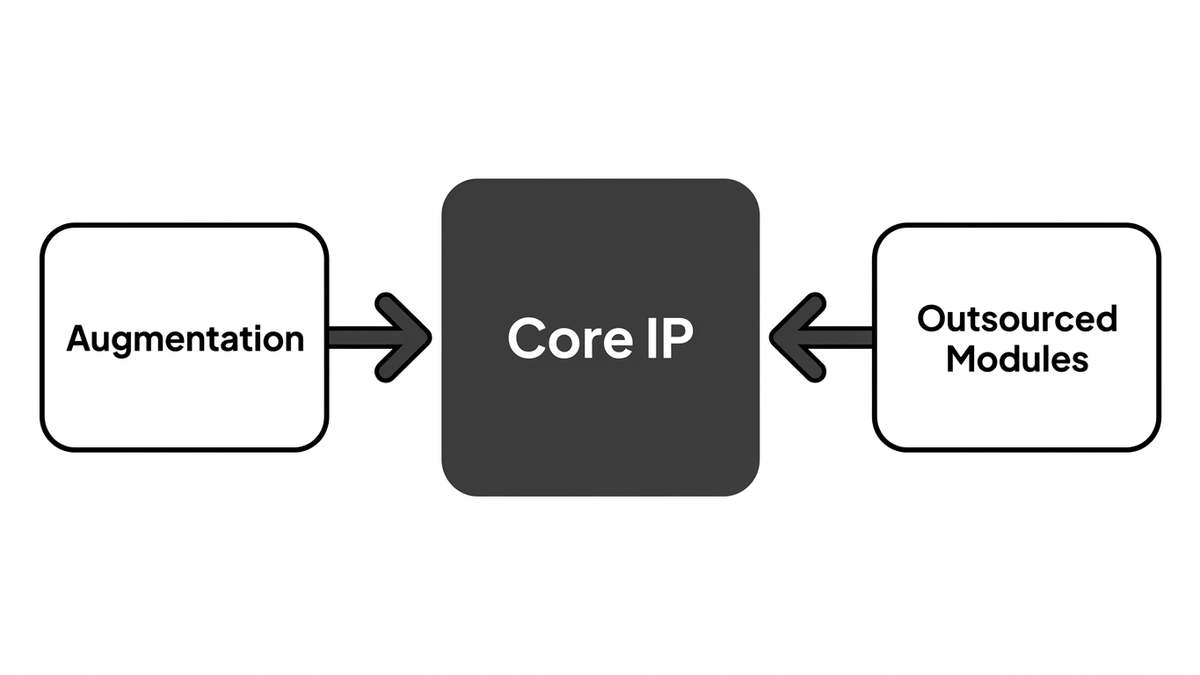
The most effective model for many Series A SaaS companies is a hybrid engagement:
- Augmentation for the core platform and differentiating IP
- Outsourcing for lower-IP or well-scoped modules
- Ongoing optimization post-launch, including A/B testing, conversion improvements, and performance fixes
Because TechOrigins covers SaaS product development, AI product development, Shopify development, and mobile apps, founders do not need a patchwork of vendors. You get one accountable partner that understands your full product surface area.
This is especially valuable when you are evaluating onshore vs offshore SaaS options. Rather than choosing purely by geography, you can focus on seniority, design capability, and product thinking, confident that startups increase engineering capacity with a model designed for growth, not just cost arbitrage.
Frequently Asked Questions
1. What is the difference between staff augmentation and outsourcing for SaaS teams?
Staff augmentation means adding external engineers into your existing team. They follow your processes, use your tools, and report into your product and engineering leadership.
Outsourcing means assigning a scoped project or module to a third-party team that manages execution. They own the project plan and day-to-day delivery, while you own product goals and acceptance criteria.
For Series A SaaS teams, staff augmentation vs outsourcing is primarily about control, knowledge transfer, and flexibility.
2. When should a Series A SaaS startup choose staff augmentation over outsourcing?
Choose engineering staff augmentation when:
- The work touches core IP or differentiating product capabilities
- Requirements are evolving and you expect multiple iterations
- You have strong internal product and engineering leadership
- You aim to keep architecture knowledge inside your org
In these cases, how to augment SaaS teams effectively becomes a critical leadership skill, because augmented engineers act as a force multiplier for your existing leaders.
3. When does outsourcing make more sense than staff augmentation?
Outsourcing is often better when:
- Scope is stable and well-defined
- The module is important but not core to your competitive edge
- You need a partner to own delivery end-to-end due to limited internal bandwidth
Examples include discrete integrations, admin tooling, compliance-driven changes, or content-heavy front-end experiences. This is where SaaS product launch outsourcing and outsourced SaaS development can provide clear cost and timeline benefits.
4. How do I scale engineering capacity quickly without losing product quality?
Use a blended model:
- Augment your core team with senior engineers who join your rituals and codebase
- Outsource non-core or well-scoped modules with clear acceptance criteria
- Maintain strict engineering standards across both models: code reviews, testing, observability, and performance budgets
Series A leaders who use this approach typically see faster delivery with fewer quality surprises, especially when working with partners experienced in engineering resource crunch solutions and custom SaaS software teams.
5. How does geography (onshore vs offshore) factor into staff augmentation vs project outsourcing?
Geography affects communication patterns, time zones, and cost, but it should not be your primary decision driver. Instead, focus on:
- Seniority of the team
- SaaS and domain experience
- Ability to integrate into your rituals and stack
- Proven track record with SaaS MVP delivery partners and dedicated SaaS teams
An offshore partner with deep SaaS experience and strong communication can outperform an onshore vendor lacking product discipline.
6. How can TechOrigins help my Series A SaaS company decide on the right model?
TechOrigins typically begins with a short discovery engagement to understand your roadmap, engineering constraints, and funding milestones. From there, we design a hybrid model that specifies which modules should use technical team augmentation and which can be treated as product development outsourcing.
Because we provide both models with senior-only teams, you avoid vendor sprawl and can adjust the mix as your needs change.
Choosing Your Next Step: Staff Augmentation vs Outsourcing
The real question is not whether staff augmentation vs outsourcing is universally better. The question is: for this quarter's roadmap and this level of risk tolerance, which model, for which module, gets us to impact fastest.
For Series A SaaS teams, a few principles tend to hold:
- Protect your core IP and evolving bets with staff augmentation vs software outsourcing so you retain control and learning velocity
- Use product development outsourcing for stable, non-core, or highly specialized modules with well-defined scope
- Favor a hybrid engagement with a partner that can do both, so you adjust the mix without switching vendors
If you are staring at an aggressive roadmap and an overloaded engineering team, TechOrigins can help you design and operate that hybrid model. Our senior-only, design-led teams have shipped 75+ SaaS and e-commerce products, and we understand how to balance speed, quality, and control for growth-stage companies.
Ready to resolve your engineering capacity crunch with the right mix of staff augmentation vs outsourcing? Reach out to TechOrigins to discuss a tailored hybrid model for your Series A roadmap.