
AI in Marketing: From Buzzword to Revenue Engine for DTC, SaaS, and Ecommerce Brands
AI in marketing has moved from experimentation to core infrastructure for growth teams. For DTC brands, SaaS companies, and ecommerce retailers, artificial intelligence is no longer a nice-to-have add-on but a primary driver of acquisition efficiency, personalization, and lifetime value.
Research bears this out. Gartner reports that 82% of marketers say AI-powered tools have improved campaign ROI (2026). McKinsey finds that 42% of businesses saw a sales uplift above 15% after integrating AI in their marketing stack (2026). The question is less "should we use marketing AI" and more "how do we apply it in a way that directly drives revenue, not noise".
This guide breaks down how AI and marketing intersect in practice: what works, where brands get stuck, and how to build an AI marketing strategy that compounds over time.
How AI in Marketing Is Reshaping the Growth Playbook
AI in marketing is not just a new tool category. It is changing the rhythm of how growth teams plan, execute, and optimize campaigns across channels.
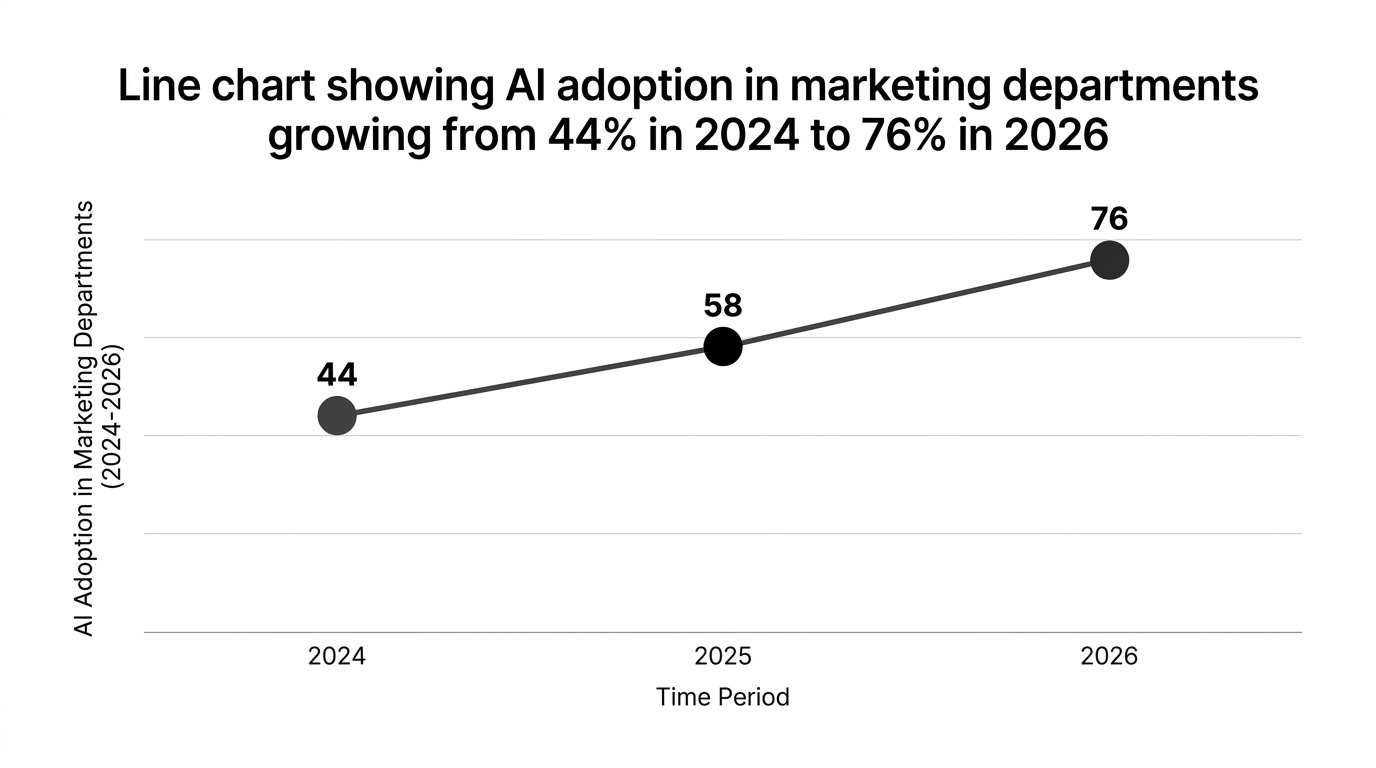
According to Salesforce research, AI adoption in marketing departments grew 31% year on year, with adoption moving from 44% in 2024 to 76% in 2026. That shift reflects a move from isolated pilots to AI being embedded across targeting, content, and analytics.
Several structural changes define this new reality:
- From calendar-based to signal-based marketing
Campaigns are increasingly triggered by customer behavior signals, product usage, and propensity scores from machine learning in marketing. Instead of fixed monthly blasts, brands orchestrate journeys that respond to user actions in real time.
- From segments to micro-cohorts
AI audience insights allow marketers to move past crude persona buckets. With advanced customer segmentation AI, similar users can be grouped by value, behavior, and likelihood to convert, often across millions of records.
- From gut feel to probabilistic decisioning
Predictive analytics replaces intuition with probability. Channels, bids, and creatives are chosen based on models that forecast conversion impact, not just last-click performance.
As Lakshmi Narayan from the Marketer AI Council notes, "AI is not just augmenting marketing, it is fundamentally rewriting how brands engage audiences" (2026). That rewrite is visible every time campaigns update themselves automatically while teams sleep.
Core Use Cases: Where Marketing AI Delivers Tangible ROI
The most mature teams focus their use of AI in marketing on a clear set of high-impact use cases. Instead of spreading effort thin, they prioritize activities closest to revenue.

1. Predictive customer segmentation
AI-powered clustering models evaluate hundreds of attributes to group users by value and behavior. Typical outputs include:
- Likelihood to purchase in the next 7, 30, or 90 days
- Churn risk scores for subscribers
- Next-best-product predictions for ecommerce buyers
IDC reports that 77% of SaaS companies have implemented predictive analytics for targeted advertising (2026). These models feed directly into ai advertising systems to prioritize spend on the cohorts that actually move.
Action starter:
- Connect your CRM, product analytics, and transaction data into a single warehouse.
- Start with a simple RFM (recency, frequency, monetary) model, then graduate to machine learning in marketing for more granular scoring.
2. AI for marketing campaigns and automated optimization
AI-based marketing platforms excel at continuous, small improvements that humans cannot execute at scale. Example applications include:
- Automated bid and budget adjustments across paid channels based on conversion probability
- Creative testing that rotates headlines, images, and CTAs toward winners
- Time-of-day and day-of-week optimization at the ad-set level
A leading marketing cloud provider found that 67% of digital marketers cite machine learning as essential for real-time campaign optimization (2026). The benefit is not only higher ROI but fewer manual knobs for teams to manage.
Action starter:
- Identify the single channel with the highest spend.
- Introduce automated campaign optimization rules that reallocate budget daily to the best-performing audiences and creatives.
- Use AI audience insights to refresh targeting weekly.
3. AI-powered personalization at scale
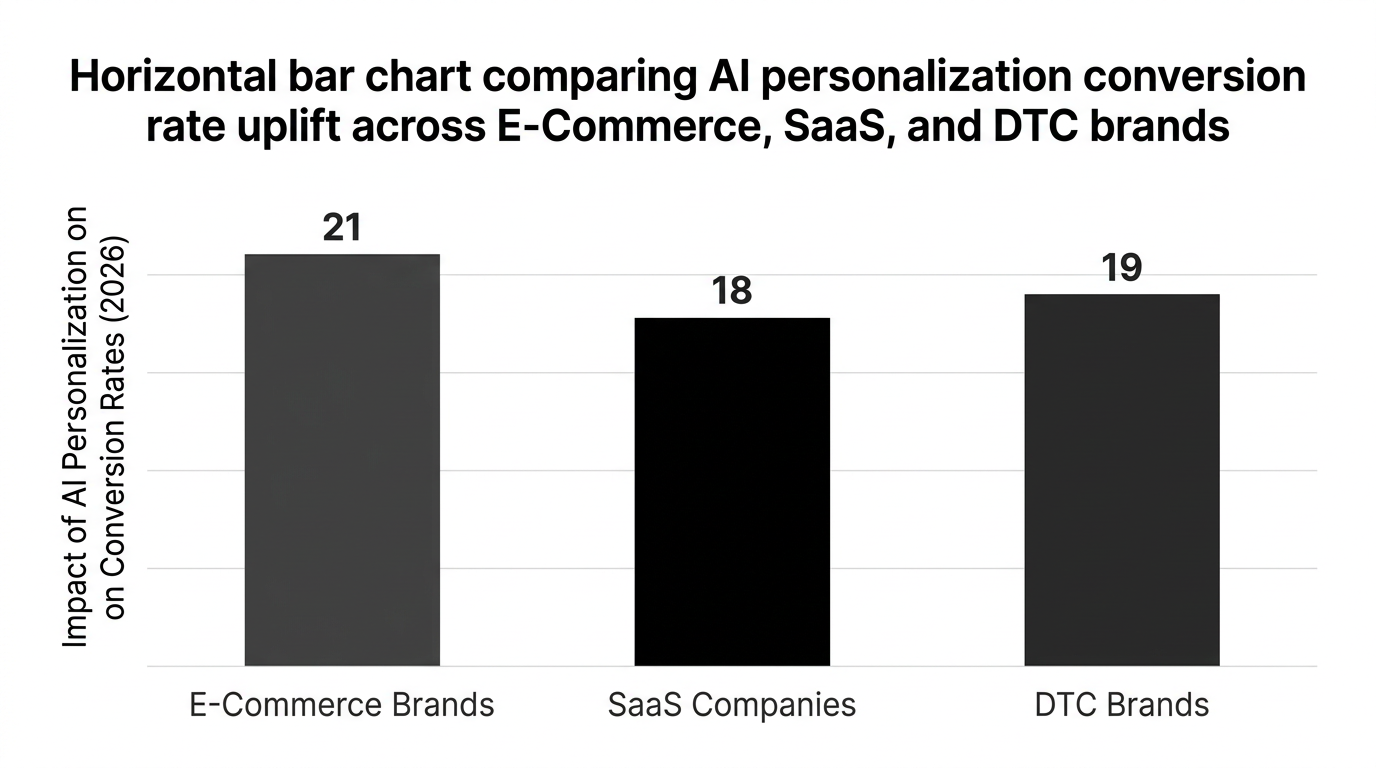
Personalization is where artificial intelligence and marketing most obviously intersect. Forrester reports that 68% of global ecommerce brands rely on AI-driven personalization to increase conversion rates, with conversion uplifts between 18% and 21% across segments (2026).
AI-powered customer experience systems can adapt:
- Homepage modules based on browsing and purchase history
- Email content blocks to reflect category interest or subscription tier
- Onsite quizzes and recommendation engines to surface the right product at the right time
For DTC and ecommerce, this translates directly into higher AOV and repeat purchase. For SaaS, it improves activation and expansion.
4. Natural language content and support
Natural language processing is reshaping how teams create and manage text-heavy touchpoints. Key uses include:
- Drafting and iterating ad copy and landing page variants
- Automatically tagging and classifying support tickets for routing
- Building AI chatbots that resolve common queries in real time
HubSpot data shows that AI-driven chatbots now resolve 85% of first-contact customer queries in retail and SaaS (2026). That directly lowers support load while keeping users inside the sales funnel.
Counterpoint: AI-generated content can dilute brand voice if left unchecked. The highest-performing teams pair automated generation with strong editorial guidelines and human review for high-visibility assets.
Building an AI Marketing Strategy That Actually Ships
Many teams talk about marketing with AI but struggle to get beyond pilots. The constraint is rarely tools. It is usually strategy, data quality, and execution discipline.
TechOrigins uses a simple framework called SCORE to implement ai marketing strategies that actually ship:
- Scope
- Capture
- Operate
- Reinforce
- Expand
Scope: Tie AI to business outcomes
The most common failure mode for ai business marketing is “AI projects” that float separate from revenue metrics. Instead, scope work around the numbers that matter:
- CAC payback period
- Conversion rate by funnel stage
- Average order value or ARPU
- Net revenue retention
For example, an artificial intelligence advertising project might be scoped as: “reduce CAC on paid social by 20% in 90 days by introducing automated bid optimization and creative rotation.”
Capture: Fix your data foundation first
AI and marketing both depend on clean, connected data. Before investing heavily in ai marketing campaigns:
- Audit tracking across web, app, and offline touchpoints.
- Standardize naming for campaigns, ad sets, and audiences.
- Consolidate data into a central analytics layer where models can access it.
A PwC study found that companies that invest in strong data foundations see up to 3 times higher returns from AI projects (2026). Without this, even the most advanced ai marketing services will underperform.
Operate: Start narrow, then deepen
Successful teams select one high-impact use case and execute it end-to-end, for example:
- AI for advertising bid optimization on a single channel
- Recommendation engine on a single high-traffic product category
- Churn prediction for the top subscription plan
Once the first use case delivers measurable uplift, they deepen models, add channels, and connect additional datasets.
Reinforce: Close the human feedback loop
AI based marketing is not “set it and forget it”. Human operators are still essential to:
- Review model outputs for bias and brand risk
- Adjust strategy when market conditions change
- Feed learnings back into training datasets
Brands who skip this step risk misaligned messaging, wasted spend, or degraded user trust.
Expand: Move from point solutions to a learning system
The long-term goal is a marketing intelligence layer that continuously learns from every touchpoint. Over time, this looks like:
- Unified identities across web, app, CRM, and support
- Shared propensity and value scores across teams
- Consistent experimentation frameworks tied to a single source of truth
At this stage, AI in marketing stops being a collection of tools and becomes part of how the business operates.
Case Examples: How AI and Marketing Drive Measurable Growth
Abstract benefits are not enough for senior operators. Concrete performance lifts from ai marketing campaigns matter more.
TechOrigins has seen this firsthand across multiple DTC and ecommerce implementations.
DTC subscriptions: Personalized flows that grow LTV
A DTC nootropics brand worked with TechOrigins to embed AI-based personalization into its subscription onboarding flow. By feeding quiz responses, browsing behavior, and order history into a recommendation model, the brand could dynamically tailor:
- Starter bundle suggestions
- Reorder cadence prompts
- Upsell offers by customer goal
The outcome was material: 38% increase in returning customers and a 26% rise in average order value in a single quarter (TechOrigins Internal Report, 2026). This is a textbook example of ai for marketing campaigns used in a way that compounds over time.
Retail ecommerce: Inventory-aware recommendations
A specialty retailer migrated to an AI-enabled Shopify Plus store built by TechOrigins. Inventory-aware recommendation engines surfaced products that were both relevant and in stock, while deprioritizing items with constrained supply.
Results included 41% higher click-through rates on product recommendations and a 19% drop in support queries (TechOrigins Client Success Data, 2026). Here, artificial intelligence and advertising were augmented by intelligent onsite merchandising, not just media spend.
Counterpoint: Not every experiment will produce double-digit gains. Some models will underperform simple rules in the short term. What matters is building a testing culture that measures incremental lift and retires underperforming ideas quickly.
How TechOrigins Helps Brands Operationalize AI Marketing
For many teams, the gap is not ideas but implementation. TechOrigins specializes in translating AI marketing strategy into shipped products that plug directly into your growth stack.
1. AI application development for marketing intelligence
TechOrigins builds custom platforms that embed marketing ai into your existing workflows. Typical components include:
- Predictive analytics dashboards that score leads, users, and accounts by revenue potential
- Customer segmentation AI engines that continuously refresh cohorts
- Real-time data insights surfaced inside tools your teams already use
Instead of juggling disconnected tools, you get a single intelligence layer that supports ai advertising decisions, lifecycle automation, and sales enablement.
2. Shopify storefronts with embedded AI modules
For DTC and ecommerce brands, TechOrigins integrates ai based marketing capabilities directly into your Shopify experience:
- Dynamic product recommendations powered by machine learning in marketing
- AI-driven onboarding quizzes that guide shoppers to the right SKU or bundle
- Inventory-aware merchandising and personalized offers on PDPs and in cart
Every build is engineered for speed, with performance-first storefronts that typically load in under two seconds. This ensures that ai marketing campaigns driving traffic do not lose users to slow experiences.
3. Performance optimization and ongoing experimentation
Post-launch, TechOrigins supports teams with ongoing optimization that uses AI and marketing data together:
- Conversion rate optimization AI to test layouts, copy, and flows
- Automated campaign optimization routines that adjust targeting and bidding
- A/B and multivariate testing frameworks connected to your marketing intelligence stack
The result is a continuous improvement loop where each experiment informs the next set of ai marketing services, instead of one-off launches.
Practical Implementation Checklist for Marketing With AI
To help you move from theory to practice, here is a pragmatic checklist you can use this quarter.
Step 1: Clarify objectives
- Choose one metric to improve first: CAC, conversion rate, AOV, churn, or NRR.
- Define a numeric target and timeframe, for example, “increase add-to-cart conversion by 12% in 90 days via personalized recommendations.”
Step 2: Inventory your data and tools
- List where key customer and campaign data lives (analytics, CRM, ad platforms, support).
- Identify gaps, such as missing UTM discipline, offline conversions, or fragmented identity.
Step 3: Select one AI use case
Starting options that work for most growth teams:
- AI for advertising bid optimization on your most expensive channel
- Personalized recommendations on your highest-revenue product category
- Churn prediction model for your primary subscription or SaaS plan
Step 4: Design guardrails and measurement
- Define success metrics and leading indicators.
- Specify brand and compliance guardrails, for example, words or audiences to exclude from ai advertising.
- Set review cadences where humans audit performance and outputs.
Step 5: Ship a minimum viable AI experience
- Start with a narrow audience or traffic slice, for example, 10% of site visitors or a single geo.
- Compare performance against a holdout group with no AI treatment.
- Iterate weekly until you see stable, statistically meaningful lift.
Over time, this approach turns artificial intelligence advertising and personalization from isolated experiments into a reliable growth engine.
FAQ: AI in Marketing for Growth-Focused Teams
1. How is AI changing the landscape of marketing?
AI is changing marketing by shifting decisions from manual and reactive to automated and predictive. Models can process far more data than humans, identify patterns in behavior, and trigger actions in real time.
This affects everything from targeting and budgeting to creative testing and customer experience. Instead of annual campaign plans, teams move toward always-on systems that adapt continuously.
2. What are the key benefits of using AI in marketing campaigns?
The main benefits of ai marketing campaigns include:
- Higher ROI through better targeting and bid optimization
- Increased conversion rates via AI-powered personalization
- Lower customer acquisition costs from automation and reduced waste
- Faster experimentation cycles and insights
Studies show that AI-based marketing automation has reduced customer acquisition costs by 29% for DTC brands (Statista, 2026). That impact compounds across channels.
3. How can businesses implement AI for better customer segmentation?
Start by consolidating data from ecommerce platforms, CRMs, analytics, and support into a single view. From there, apply clustering or propensity models to group customers by value, likelihood to buy, or churn risk.
Even simple models can outperform static personas. Over time, feed these segment scores into ai for marketing campaigns, lifecycle flows, and sales prioritization so that budget and attention align with value.
4. What types of marketing tasks can be automated with AI?
Common candidates for automation include:
- Bid adjustments and budget pacing for ai for advertising
- Subject line, headline, and creative variant testing
- Product recommendations and dynamic content on site and in email
- Lead scoring and routing in the sales funnel
- FAQ-level support queries through chatbots
The goal is to free humans for higher-order strategy and creative work, while AI manages repetitive, data-heavy tasks.
5. How does AI-powered personalization impact customer engagement?
AI-powered personalization typically increases relevance, which drives higher engagement and conversion. Forrester reports conversion uplifts around 18% to 21% for brands using advanced AI personalization across ecommerce and SaaS (2026).
Customers see products, content, and offers that match their behavior and context rather than generic blasts. The key is to avoid being intrusive: transparency and easy preference controls help maintain trust.
6. What are examples of successful AI marketing strategies?
Effective strategies usually focus on a clear value chain. Examples include:
- Subscription brands using churn prediction to trigger save offers and education sequences
- Ecommerce stores running inventory-aware recommendation engines to improve AOV
- SaaS teams using predictive lead scoring to focus sales on the highest-intent accounts
In each case, the use of AI in marketing is directly tied to a measurable revenue outcome, not just experimentation for its own sake.
Turning AI in Marketing into a Revenue Engine
Used thoughtfully, AI in marketing can become a compounding advantage for DTC, SaaS, and ecommerce brands. The evidence is clear: higher campaign ROI, better personalization, and concrete sales uplift when AI is integrated into the marketing stack.
The opportunity now is to move from scattered tools to a coherent AI marketing strategy linked to business outcomes. That means strong data foundations, focused initial use cases, tight feedback loops, and partners who can translate models into shipped products.
TechOrigins specializes in helping brands do exactly that by combining AI application development, Shopify engineering, and performance optimization into a single, senior-led engagement. If you are ready to operationalize marketing with AI for real revenue impact, speak with TechOrigins about your next AI marketing initiative.