
Most AI startup ideas die in the prototype phase, here's how to ship yours to production instead.
AI app development for startups is no longer a moonshot. In 2026, it is a funding prerequisite and a core driver of speed to market.
CCI survey reports that 67% of startups using AI app development accelerate time-to-market by at least 30% compared with traditional builds (IDC, 2026). At the same time, Gartner projects the global AI software market will reach 184 billion dollars by 2026, with startups contributing 36% of new production-ready AI apps.
The question is not "should we build AI" but how to move from idea to a production-grade AI app that investors trust, users adopt, and your team can operate.
This guide breaks down a practical, founder-centric path: from refining your AI idea and scoping an MVP, through tech stack decisions and launch, to mistakes to avoid and how an experienced partner like TechOrigins fits in.
Why AI App Development For Startups Is Different From Traditional Software
For startups, AI product development is not just another feature track. It changes how you validate value, handle risk, and design your roadmap.
A PitchBook analysis shows that 48% of early-stage SaaS and eCommerce startups now launch with at least one AI feature in their core offering (PitchBook, 2026). That makes AI a baseline expectation, not a novelty.
What makes AI app development for startups unique?
- Probabilistic behavior instead of deterministic logic. Outputs are not always predictable, which impacts UX, QA, and support.
- Data is part of the product. Quality, availability, and governance of data directly shape product value.
- Continuous learning beats static releases. Models need monitoring, evaluation, and iteration in production.
A useful analogy: traditional software is like building a bridge, while AI products are like running a train network. The bridge is a one-time build; the network needs constant scheduling, monitoring, and tuning.
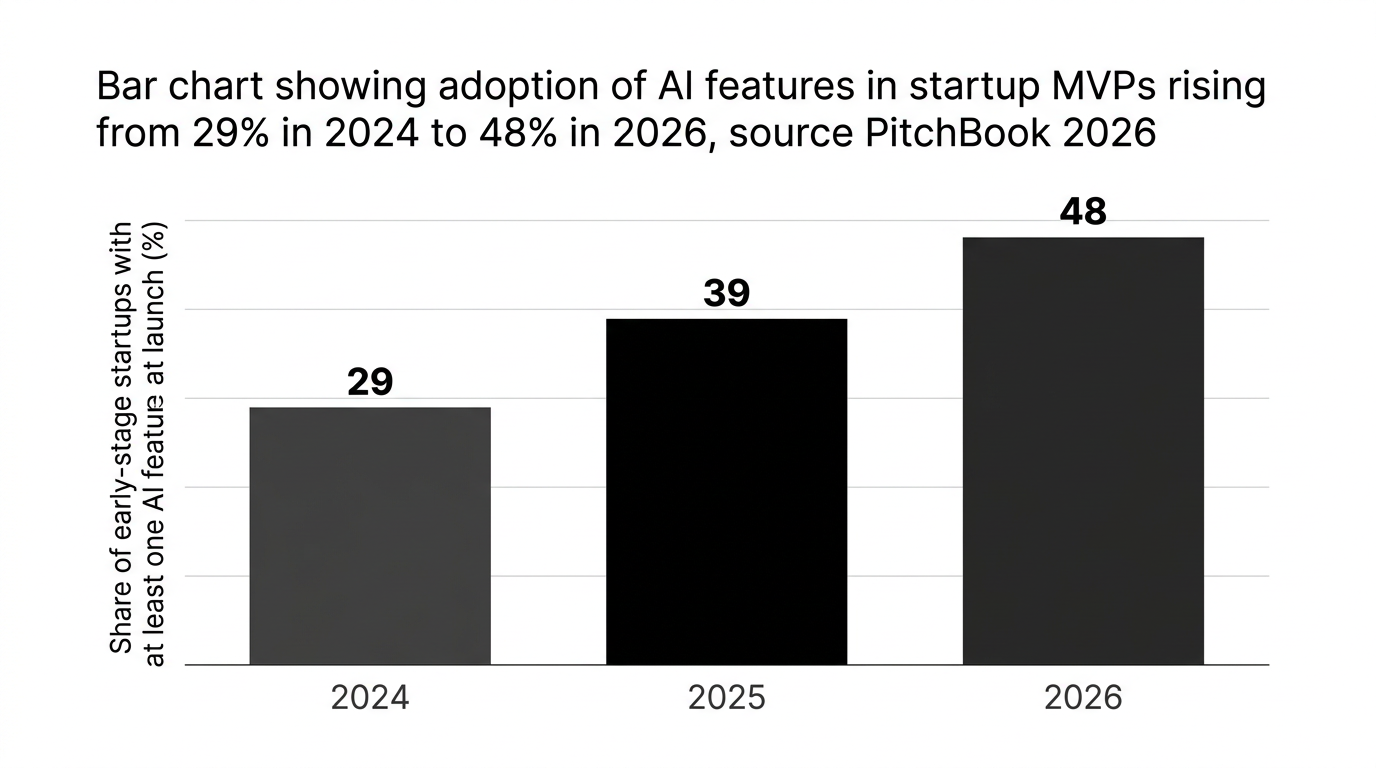
Bar chart showing bar chart showing adoption of ai features in startup mvps rising from 29% in 2024 to 48% in 2026, source pitchbook 2026 — data visualization for share of early-stage startups with at least one ai feature at launch (%) Startups that adopt custom AI app development services gain a measurable edge. One funding study reports that these startups are 2.1x more likely to attract seed or Series A rounds compared with peers who do not invest in AI (CB Insights, 2026).
The 5D Framework: From AI Idea To Production-Ready MVP
To bring structure to AI app development for startups, TechOrigins uses a 5D framework: Discover, Design, Develop, Deploy, and Drive.
Instead of jumping straight into model choices or API calls, this framework keeps the focus on business value and risk control.
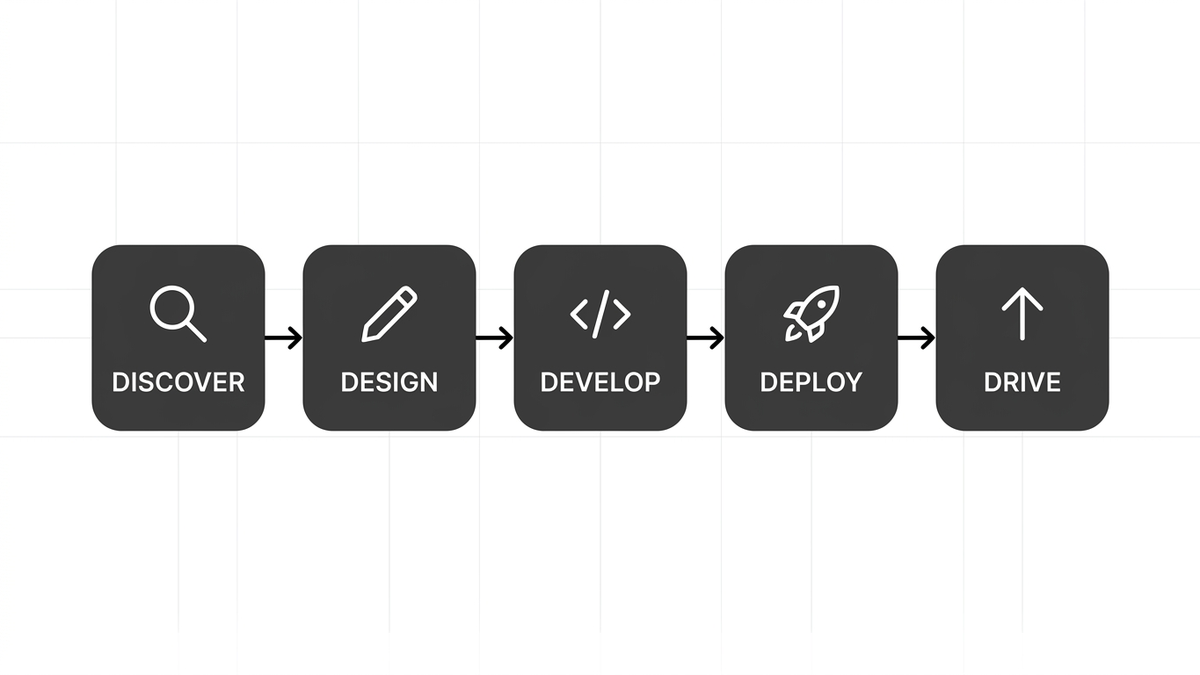
Five-step horizontal process diagram of the 5D framework: Discover, Design, Develop, Deploy, Drive
1. Discover: Clarify the Problem and the AI Advantage
The first step is not architecture, it is problem clarity.
Founders should answer four concrete questions:
- Who is the primary user, and what decision or action will AI improve?
- What does "better" look like in numbers, for example higher conversion, lower support tickets?
- What data do we already have, and what do we realistically need?
- How will we measure AI success separately from overall product success?
For example, in AI product development for startups in SaaS, you might aim to reduce onboarding time by 40% with AI-driven setup flows. In eCommerce, you might aim for a 25% lift in first-purchase rate with AI-powered product discovery.
Forrester notes that 52% of founders consider rapid AI MVP development critical to survival and differentiation (Forrester, 2026). Discovery is where you define that differentiation in hard terms.
2. Design: Scope the AI MVP, Not the Fantasy v3.0
Next comes AI MVP development for startups: deciding the smallest meaningful slice that proves value.
A practical AI MVP should:
- Address one high-impact, narrow workflow, not a broad domain.
- Use a simpler model or external service first, then evolve to custom models later.
- Include basic guardrails for input validation, rate limiting, and fallbacks.
A useful approach is the "AI Spine" model: pick one critical workflow and run AI through its center. For a SaaS analytics app, this could be an AI assistant that explains dashboards. For an eCommerce store, this could be an AI product finder.
TechOrigins often defines MVP success in one of three ways:
- Time saved per user session.
- Conversion uplift in a key funnel step.
- Reduction in manual workload for your team.
3. Develop: Choose Tech Stack, Models, and Architecture
Only after problem and scope are clear should you select the tech.
Key decisions include:
- Tech stack for AI app development: language and framework for the app layer, plus AI orchestration libraries.
- Model strategy: hosted APIs, open-source models, or custom fine-tuned models.
- Data pipelines: ingestion, cleaning, feature stores, and storage.
- MLOps basics: model versioning, monitoring, and rollback.
Market research shows that modular, production-grade AI frameworks can reduce AI MVP build times by about 41% (AI Software Report, 2026). For startups, that often means combining a familiar web stack with specialized AI components instead of building everything from scratch.
TechOrigins typically uses:
- Hosted LLMs or open-source LLMs for language tasks.
- Vector databases for retrieval-augmented generation.
- Event-driven services for real-time AI features.
4. Deploy: From Demo to Production-Ready
Moving from a demo to production involves more than changing environment variables.
To be considered truly production-ready, your AI MVP needs:
- Authentication and authorization hooks.
- Monitoring and logging for model calls, latency, and error rates.
- Usage and cost tracking by tenant or customer.
- Performance budgets for AI calls within your overall response-time SLOs.
IDC data suggests that startups that invest in proper AI deployment workflows are more likely to achieve the 20 to 40 percent time-to-market reduction bracket.
5. Drive: Iterate With Real Feedback and Data
The launch is not the finish line. AI products need continuous improvement, not quarterly updates.
Key practices:
- Capture explicit user feedback on AI outputs.
- Track model performance and business KPIs together.
- Experiment with prompts, retrieval strategies, or model versions.
As one AI strategist notes, "Rapid iteration and real-world feedback loops are the lifeblood of successful AI app launches" (AI Founders Forecast, 2026). Startups that thrive treat their AI as a living system, not a feature frozen in time.
SaaS vs eCommerce: Different Paths, Same AI Core
AI app development for startups looks different if you build a B2B SaaS product versus an eCommerce brand. The underlying AI capabilities overlap, yet priorities, UX, and metrics diverge.
AI SaaS Product Development
For AI SaaS product development, priorities are often:
- Self-service onboarding that compresses time-to-value.
- Decision support inside workflows, for example recommendations or explanations.
- Automation of routine tasks, for example summarization or classification.
Research on SaaS startups shows that AI-powered onboarding and support can increase customer retention by 23% compared with SaaS products without these capabilities (SaaS Pulse, 2026).
If you want to build AI features into a SaaS product, common starting points include:
- AI setup assistants that configure the account based on a short conversation.
- In-product AI guides that answer "what does this metric mean" in context.
- Automated drafting of reports, emails, or playbooks.
Custom LLM integration for SaaS startups is becoming standard. One benchmark finds that custom LLM integration leads to a 38% rise in user engagement (AI Startups Benchmark Report, 2026).
AI App Development For Ecommerce Stores
For AI app development for ecommerce stores, the most valuable workflows tend to be:
- Dynamic product recommendations.
- AI-powered search and product discovery.
- Pricing and promotion optimization.
- AI chatbot development for ecommerce websites that can sell, not just answer FAQs.
A major eCommerce trends study shows that 65% of new eCommerce startups integrate AI for product discovery and recommendations at launch (eCommerce Trends, 2026).
This is where an ecommerce AI development company can add value, especially if they also handle Shopify or similar ecosystems. The combination of storefront development and AI experience matters, because the best AI features connect tightly with merchandising, checkout, and marketing stacks.
Cost To Build An AI App For A Startup
Founders often ask about the cost to build an AI app for a startup. The truthful answer is that it depends on scope, data, and the level of integration. However, we can outline ranges and cost drivers.
Key Cost Drivers
- Problem complexity: classification and search are typically cheaper than custom generative models.
- Data readiness: well-structured existing data reduces cost; messy or missing data increases it.
- Experience level of the team: senior AI engineers and product strategists cost more per hour but reduce rework.
- Hosting and inference costs: model choice and traffic shape ongoing spend.
For a typical seed-stage startup, an affordable AI app development for startups package is one that gets a working, testable, production-ready MVP into users' hands in 8 to 12 weeks without locking you into a brittle architecture.
Although exact numbers depend on the region and scope, most founders should budget for:
- A focused AI discovery and design phase.
- Core AI feature implementation plus surrounding UX.
- Basic MLOps, monitoring, and observability.
- A small buffer for post-launch iteration.
Outsource AI Development vs In House For Startups
The decision to outsource AI development vs in house for startups is strategic. It shapes your speed, burn rate, and future hiring plan.
A funding analysis in 2026 found that 72% of seed-funded startups prefer working with specialized AI software development agencies instead of building full internal AI teams immediately (CB Insights, 2026).
When Outsourcing Makes Sense
Outsourcing to an AI application development company for startups is usually superior when:
- You need to ship in 3 to 4 months to validate fundraising or market traction.
- Your core moat is distribution or domain expertise, not AI research.
- You lack senior AI product leadership in-house.
In this context, a senior AI software development agency can behave like an extension of your founding team, bringing both architecture and product thinking.
When In-House Is Justified
Building in-house is justified when:
- AI research is the core differentiator and requires proprietary techniques.
- You already have a strong engineering team with AI experience.
- You are at Series B or beyond with budget for a full AI platform team.
A sensible hybrid for early stages is to work with an AI app development agency for seed funded startups, then gradually hire in-house engineers while the external team focuses on complex features and platform evolution.
Case Study: From Concept To Funded AI MVP In 8 Weeks
A useful way to see this in motion is through a composite case inspired by multiple 2026 startup journeys.
A B2B SaaS startup wanted to help sales teams prioritize deals using AI. They had domain expertise and some CRM data exports, but no AI or data engineering team.
Working with a specialized AI partner, they:
- Clarified the problem and designed a narrow MVP that scored deals and suggested next actions.
- Chose a practical tech stack combining a web app, retrieval-based AI layer, and standard CRM integrations.
- Implemented an AI assistant that explained each score, not just output a number, which reduced user resistance.
- Added monitoring to compare AI scores with actual outcomes and refined the model over 3 iterations.
The result: a production-ready AI MVP shipped in 8 weeks that improved trial-to-paid conversion by double digits and helped them secure a seed round.
This pattern is typical for AI app development for startups: focus on one high-value workflow, move fast with a realistic model choice, then iterate with live data.
How TechOrigins Supports AI App Development For Startups
TechOrigins is a senior-only AI application development company for startups. The team has shipped more than 75 products across AI apps, SaaS, and high-conversion eCommerce stores.
For founders, TechOrigins is a single partner that can cover strategy, design, development, AI, and post-launch support.

Senior product and engineering team collaborating with a startup founder reviewing AI app wireframes in a modern workspace
Custom AI App Development Services For SaaS Startups
TechOrigins delivers custom AI app development services that cover:
- AI product strategy and problem framing.
- UX and UI design tailored for AI interactions.
- Integration of LLMs, vector search, and analytics pipelines.
- MLOps setup for logging, monitoring, and model updates.
For AI SaaS product development, TechOrigins often builds:
- AI-powered onboarding and configuration flows.
- In-app AI assistants that explain complex data.
- Workflows that use AI to draft content, recommendations, or actions.
This supports use cases such as AI powered onboarding and support for SaaS apps, where TechOrigins helps startups implement chat-like helpers and contextual tips that improve activation and retention.
AI App Development For Ecommerce Stores
TechOrigins is also an ecommerce AI development company, particularly for brands using Shopify and similar platforms.
For AI app development for ecommerce stores, TechOrigins builds:
- AI-powered product discovery experiences, such as quiz-based finders and conversational search.
- Recommendation systems that adapt to both behavioral and catalog data.
- AI chatbot development for ecommerce websites that integrates with inventory, orders, and support systems.
This is tightly integrated with TechOrigins' Shopify development services, so AI experiences feel native to the storefront and the analytics stack.
AI MVP Development And Affordable Launch Plans
TechOrigins provides AI mvp development for startups with:
- A clear 5D framework and 8 to 12 week delivery windows.
- Weekly demos and transparent scope management.
- Post-launch tuning for model performance.
For founders looking for affordable AI app development for startups, TechOrigins avoids over-engineering. The focus is on a path that is:
- Fast enough for investor timelines.
- Robust enough for production.
- Flexible enough to evolve as you learn.
FAQs: AI App Development For Startups
1. How can startups turn an AI app idea into a production-ready product?
Start with a sharp problem statement, not a feature wish list. Use a framework like Discover, Design, Develop, Deploy, and Drive to move in stages.
Define one workflow where AI can produce measurable improvement, validate it with a narrow MVP, choose pragmatic models and infrastructure, and build in monitoring from day one. Working with an experienced partner, such as TechOrigins, helps compress this cycle and avoid early architectural mistakes.
2. What are the steps for MVP development in AI for startups?
AI MVP development for startups usually follows these steps:
- Problem discovery and success metrics.
- MVP scope definition around one workflow.
- Data and model strategy design.
- Implementation of AI plus necessary UX and backend.
- Production hardening, including authentication and monitoring.
- Iteration based on real-world usage.
Each step should be time-boxed and produce tangible artifacts: problem briefs, wireframes, data schemas, and working builds.
3. How do you choose the best tech stack for AI app development?
Start from the product requirements and your team's existing skills. For many startups, the best tech stack for AI app development is a familiar web framework plus specialized AI components, such as hosted LLMs, vector search, and an observability stack.
Avoid over-optimization too early. Choose tools that make experimentation fast and that your team or partner can operate reliably. TechOrigins typically recommends stack choices that balance performance, cost, and hiring feasibility.
4. What are common mistakes in AI app development for startups?
Common mistakes include:
- Building a generic AI "platform" instead of solving a specific problem.
- Underestimating data quality issues.
- Ignoring UX, which leads to mistrust of AI outputs.
- Skipping monitoring and feedback loops.
Another subtle mistake is over-investing in custom models before validating that users care about the workflow at all. It is usually better to validate value with simpler components first.
5. How does AI app development differ for SaaS vs eCommerce startups?
For SaaS, AI usually focuses on analytics, onboarding, and workflow automation. Success is measured in activation, retention, and productivity gains.
For eCommerce, AI emphasizes product discovery, personalization, pricing, and customer support. Success is measured in conversion rate, average order value, and reduction in manual support tickets.
The underlying techniques can be similar, but UX, data sources, and KPIs differ, so your roadmap and architecture should reflect that.
6. What is the cost to build an AI app for a startup?
Costs vary with scope, data readiness, and depth of integration. A focused AI MVP that ships in 8 to 12 weeks is usually the right target for seed-stage teams.
An experienced AI partner can help structure a phased plan that spreads cost across discovery, MVP, and post-launch optimization. TechOrigins works with founders to define budgets that fit fundraising stages while still delivering production-ready quality.
Bringing Your AI Startup Vision To Life
AI app development for startups is now a necessity, but it does not have to be chaotic or experimental at all costs. With a structured framework, pragmatic tech choices, and a focus on one high-value workflow, you can move from idea to production-grade AI in a matter of weeks, not years.
The most successful teams treat AI as a product capability tied to clear metrics, not an isolated research project. They validate value quickly, instrument everything, and then deepen sophistication as traction grows.
If you are ready to scope, build, or accelerate your AI product, TechOrigins can help you define a realistic path from concept to production-ready AI MVP for your SaaS or eCommerce startup.
Visit TechOrigins at https://techoriginshq.com/ to discuss your AI roadmap.